I'm evaluating Retool for use within the business, and I've chosen to take a look at one of my ongoing projects in PowerApps as a possible project.
We have a number of complex products for which we have existing configurators implemented in Excel/Access/whatever, and we're looking at replacing all of these with a single system with version control etc. These configurators could have over one hundred choices, and I would therefore like to drive this from data, rather than dropping hundreds of combo boxes onto the form.
As you'd expect, some choices affect other choices, so that the entries in each combo box should be filtered depending on previous choices, or marked as invalid when changes are made to previous selections. Obviously it's also necessary to be able to save configuration and to reload saved configurations for editing.
As part of a similar evaluation, this has been prototyped in PowerApps, where the configurator itself, including the validation data, is contained in a single Sharepoint list. This performs about as well as you'd expec, but is copied to a local collection for use.
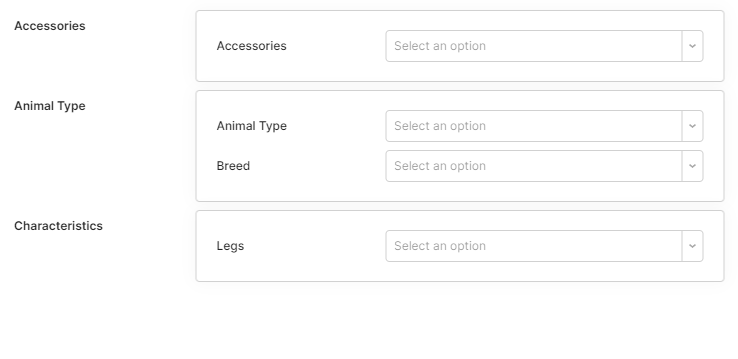
The configurator with Demo selections looks like this:
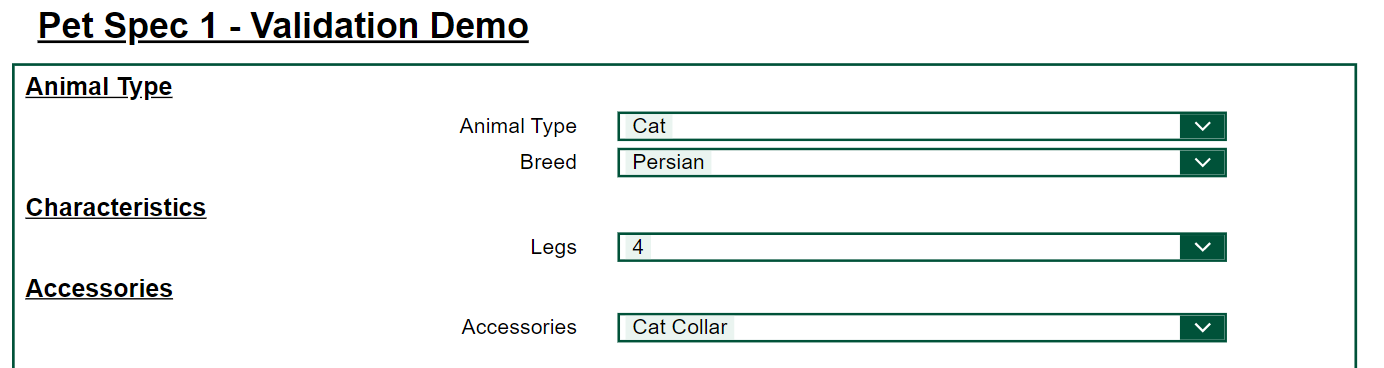
This is done in PowerApps with a gallery control inside a gallery control. The outer gallery is populated with distinct categories from the sharepoint list, inner galleries are populated with specification names where the category equals the category for the outer item, and so on. PowerApps allows you to reference the entries for each item in the gallery and use that within the query, either by the name of the control within the gallery, or by using ThisItem.
All aspects of this are working in PowerApps, but the performance is not ideal, and the backend options for PowerApps are not ideal for us either.
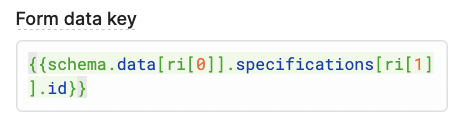
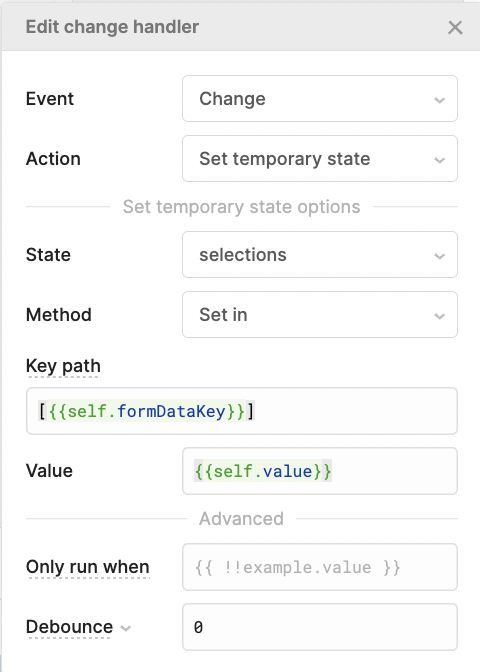
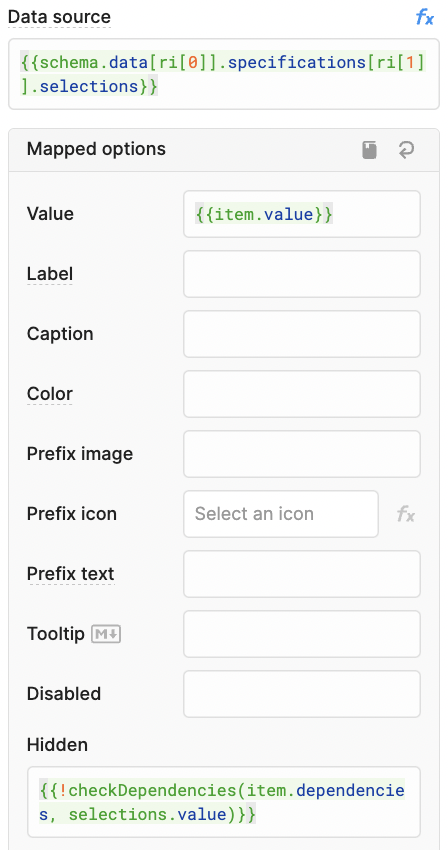
What I'm struggling to understand is how this can be done in Retool. I can use nested lists in Retool as a basis for this, but it appears that I need to provide a complete dataset with all data pre-filtered and ready to display, and that I can't refer to the records inside the outer list to filter data further in.
Am I misunderstanding something here, or going about it in the wrong way? I'm not fussy about the controls used to achieve the effect, but the UI needs to be driven by the data, so other options might need to add controls on the fly according to the data. I realise that doing away with the category headings would simplify matters, but it's a long list without them, and not ideal.
Thanks in advance for any advice.
Andrew